What is IoT and what does it mean for your business?
We’re going to explore how IoT is transforming industries across the UK, and how...








SD-WAN and MPLS serve the same purpose of connecting different locations through a computer network, allowing local branches to access and share information and systems from a central platform. However, they do it in very different ways, so in this article, we’re going to take a look at the difference between SD-WAN and MPLS to help you identify which solution is best for your business.
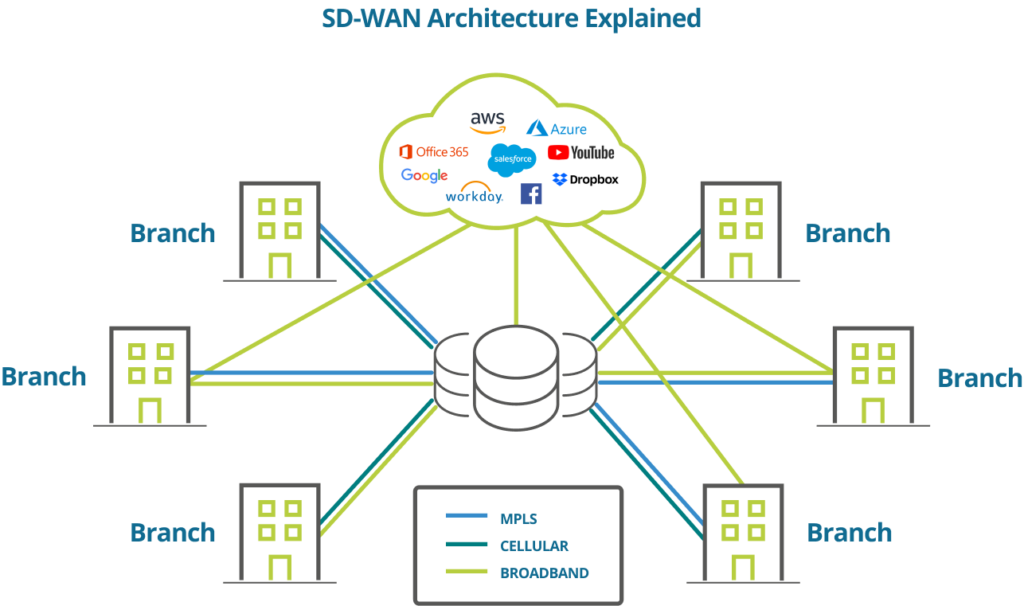
Software-Defined Wide Area Network (SD-WAN) allows organisations to connect their branch offices, data centres, and cloud resources over multiple internet connections. SD-WAN improves performance by intelligently routing traffic over the network, prioritising high-priority applications and traffic over lower-priority tasks. This optimising of bandwidth usage enhances the efficiency of the network and the overall user experience by ensuring important tasks aren’t competing with other tasks for bandwidth. For example, with SD-WAN, it’s possible to dedicate parts of the network for video conferencing, allowing users to carry out this task without competing for bandwidth with web browsing or email traffic, which is also running over the network.
Furthermore, SD-WAN provides greater flexibility and control for network administrators, allowing them to easily make changes through a centralised management interface, allowing for rapid deployment and configuration modifications. Potential issues like bottlenecks or suspicious activity can be more easily identified and resolved. This is compared to traditional Wide Area Networks (WANs) and MPLS, which can require configuration changes across several local connections individually. On top of this, the rise of 5G networks now further enhances SD-WAN, as businesses can take advantage of high-speed, low-latency connections to improve network performance and reduce downtime.
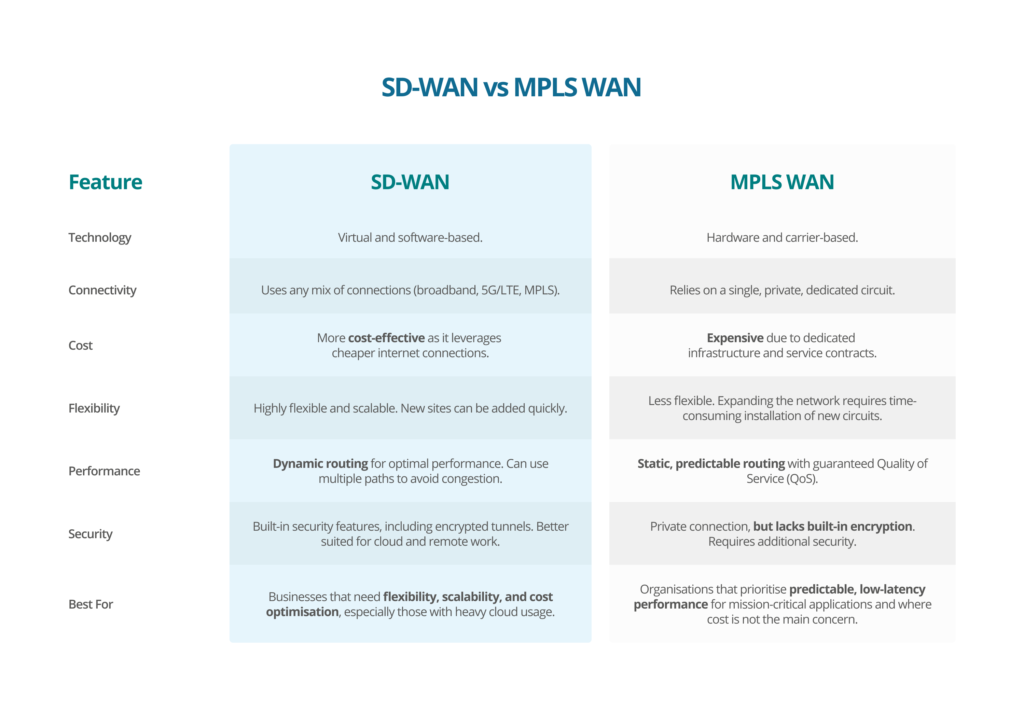
Multiprotocol Label Switching (MPLS) has been the standard for wide-area networking for decades. A key advantage of MPLS is its ability to operate on dedicated circuits, which can provide high reliability and consistent network traffic performance for data sharing between locations and data centres. MPLS often comes with Service Level Agreements (SLAs) that guarantee a minimal performance level.
However, while MPLS offers high performance on par with SD-WAN, it can be much more expensive to deploy and manage and inflexible, making scalability a bigger challenge. This is because, unlike SD-WAN, which takes advantage of internet connections, MPLS requires dedicated connections between local branches and data centres to access or share information over a central network. These lines would need to be installed and managed at every local site, which can increase costs and administration.

Performance is another crucial aspect to consider when comparing SD-WAN and MPLS. MPLS offers reliable performance because it’s built over dedicated circuits with guaranteed service levels.
It’s sometimes stated that SD-WAN is behind in performance because it’s reliant on public internet connections, which can experience dips in performance based on capacity and usage, but this is no longer the case. Modern SD-WAN incorporates advanced traffic management techniques, such as dynamic path selection and quality of service (QoS) prioritisation, ensuring optimal performance even over standard broadband connections. This AI-driven traffic management helps ensure priority traffic is routed to parts of the network with higher bandwidth, reducing latency risks. Because SD-WAN prioritises traffic intelligently, real-time applications like video conferencing and file transferring apps remain smooth and reliable, even during peak times.
Additionally, 5G networks are significantly enhancing SD-WAN’s ability to maintain optimal performance by providing faster speeds and more reliable connections, particularly for mobile and remote users.
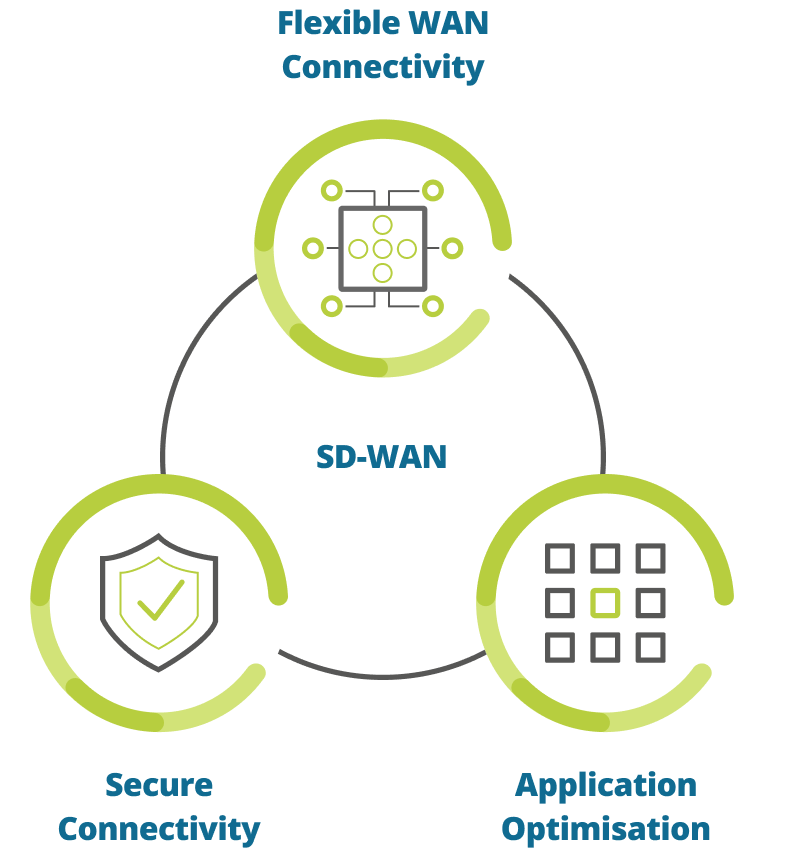
The use cases of SD-WAN are hard to ignore. Its cost-effectiveness, flexibility, and ability to optimise traffic routing make it an attractive option for businesses of all sizes. With SD-WAN, organisations can reduce reliance on expensive MPLS circuits, leverage multiple connections for improved performance, and simplify network management through central controls and automation. SD-WAN also provides the agility to adapt to changing business needs and easily integrate with cloud-based applications and services.
If you want to upgrade your network connectivity and performance, explore our SD-WAN solutions at Elite Group. We provide various solution options to fit your budget, including hybrid approaches, ensuring your business can collaborate over a high-performing, secure network and benefit from uninterrupted access to critical applications. Contact us today, and our business broadband internet specialists will work closely with you to implement SD-WAN within your business efficiently.
Are you ready to transform your business communications? Please fill out your details and submit the enquiry form and will contact you at the earliest opportunity. Get ready, your journey starts here!

Explore Elite Group's latest industry updates, insights, and practical guidance, designed to help your business make better technology decisions.